Asia’s Energy Shock: The Iran War and the Cost of Fossil Dependence
by Dick Edwards, Senior Partner, ACE Partners“Philippines declares energy emergency over Middle East conflict risk.”
“Thailand orders bureaucrats to use stairs and work from home in energy saving drive.”
“Vietnam Airlines plans domestic route cuts due to jet fuel shortage, regulator says.”
These headlines, all from the past few weeks, show how quickly a geopolitical conflict can turn into an energy crisis across Southeast Asia. What begins as disruption in distant fuel routes does not stay confined to regional oil markets for long; it starts reshaping government decisions, transport systems, and business operations across the globe, particularly in Asia.
A Chokepoint Asia Cannot Ignore
Asia’s dependence on the Strait of Hormuz is best understood in physical terms: a single narrow passage carries a critical share of the fuels powering the region. When conflict interrupts that route, the effects ripple quickly through power systems, transport networks, industrial supply chains, and public budgets across Asia.
Roughly 20% of global oil and LNG flows pass through the Strait, and around 85–90% of Hormuz crude flows go to Asia. Two-thirds of Asian oil demand depends on this single route. The current crisis exposes a deeper structural vulnerability: an energy system still built on imported fossil fuels, concentrated supply routes, and limited flexibility under stress.
The scale of disruption is already significant. An estimated 10 million barrels per day have been affected, with another 15 million barrels per day at risk if the Strait remains blocked. Oil prices surged to around $115–120 per barrel. Alternative routes and pipelines can carry only a fraction of normal volumes, and some face security risks of their own, evidenced by the latest Iranian attack on the East-West pipeline across Saudi Arabia to the Red Sea. Even partial disruption, therefore, has disproportionate effects.
More Than an Energy Story
This crisis extends far beyond fuel supply. While oil and LNG are the most visible impacts, disruptions also affect jet fuel, fertilizer inputs, helium for semiconductor production, and other critical commodities. The result is not just an energy shock, but a broader strain on trade, food systems, and macroeconomic stability.
Governments across Asia are responding with the tools available: reserve releases, fuel rationing, mobility restrictions, reduced workweeks, and demand curtailment. These responses differ by country but point to a shared reality—when fossil fuel systems are under pressure, the fastest response is often not substitution, but suppression. Demand is cut because supply cannot be secured quickly enough.
Even if the conflict de-escalates soon in light of the recently announced cease-fire, the disruption will persist. Supply chains may take three to four months to normalize, prolonging the economic impact.
What Needs to Change in Southeast Asia
The response must be practical rather than rhetorical. The first priority is reducing reliance on imported fossil fuels through measures that provide a less vulnerable, more stable energy supply: tighter energy efficiency, stronger demand-side management, accelerated renewable integration, and more flexible electrification across transport, heating, and industry. Energy security cannot be defined only by securing more fuel from abroad—it must also mean needing less of it.
This shift also reframes reliability. Fossil fuels have long been treated as inherently dependable, but this crisis shows how fragile that assumption becomes when supply depends on contested shipping routes. Renewable energy sources like solar and wind still require storage, grid management, and flexibility. However, they are not exposed to maritime chokepoints, insurance shocks, or fuel import disruptions in the same way. Local generation is therefore not just cleaner—it is less geopolitically vulnerable.
What This Means for Business
For businesses, the implications are immediate and operational. The most relevant actions include reducing energy consumption, improving demand management, electrifying processes where possible, and diversifying away from fuel-dependent systems. This includes accelerating the adoption of electric transport, electric heating, and energy systems less reliant on imported oil and gas.
While transformation cannot happen overnight, rising fuel insecurity increases the cost of delay. At the same time, firm-level action alone will not be sufficient. Many companies face barriers not only in technology, but in financing and implementation pathways.
This highlights the importance of practical advisory support, industry partnerships, and cluster-based approaches that can accelerate collective progress. If the lesson of this crisis is taken seriously, the response will not be limited to a temporary scramble for supply, but a sustained effort to reduce structural dependence on imported fossil fuels, with the added benefit for Asian companies of accelerating the achievement of their decarbonization goals.
Join the Discussion
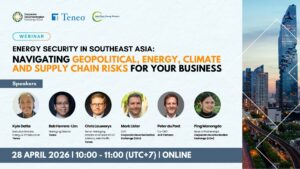
The Southeast Asia Corporate Decarbonization Exchange (CDx), in collaboration with Teneo, is supporting private sector and financial clients in accelerating the energy transition. On Tuesday, 28 April at 10:00 AM Bangkok time, CDx and Teneo will host a one-hour webinar.
The session will explore the implications of the US–Iran conflict for Southeast Asia’s private sector and identify opportunities to mitigate associated risks. Teneo brings global expertise in energy markets and strategies to address energy security and affordability challenges, while CDx contributes regional market intelligence, stakeholder engagement, and practical advisory support.
Register Here, and for further enquiries about CDx’s support for corporate decarbonization in Southeast Asia, contact Ping Manongdo at ping.m@seasia-cdx.com.