Thailand’s Climate Finance Landscape: Closing the $17 Billion Gap
by Peter du Pont (Co-CEO) and Drishti Chhibber (Communications Associate)Thailand’s path to net zero is paved with ambition — but not enough capital. Even as billions pour into solar farms, wind projects, and electric vehicles, a far larger financing gap looms. To stay on track, Thailand needs up to USD 28 billion in climate investment each year, yet current flows barely cover half of that. The result: an annual shortfall of USD 11–17 billion that could define whether the country’s energy transition gains momentum or loses it.
In 2025, the Asian Development Bank (ADB) published research from its Thailand’s Climate Finance Landscape report, which pulled back the curtain on where climate finance is flowing, where it isn’t, and what it will take to close the gap.
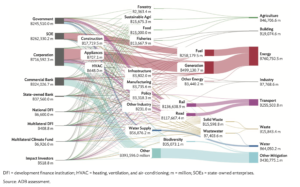
Figure 1. Climate Mitigation Finance in Thailand by Sources and Uses of Funds, 2018 – 2024 (THB million)
This research marked Thailand’s first publicly available, end-to-end mapping of climate finance flows, covering more than 660 projects across sectors. The results are striking. From 2018 to 2024, climate mitigation investment totalled THB 1.6 trillion (USD 47 billion). Energy dominated with 48% of flows, transport followed at 16%. Adaptation — which funds water management, disaster resilience, and climate-smart agriculture — accounted for less than 1%, leaving these critical sectors severely underfunded.
The funding has been driven largely by the private sector. Corporations and commercial banks together provided more than 60% of total climate finance, primarily for renewable energy and electric vehicle infrastructure. Meanwhile, sectors such as agriculture, water, waste, and adaptation remain far from the scale needed.
Table 1. Analysis of Thailand’s NDC Investment Gap
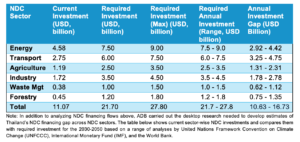
The shortfall is significant. To meet its NDC and net-zero commitments, Thailand will need USD 22–28 billion in climate investment each year between 2030 and 2050. Current flows fall short by around 50%, leaving an annual gap of USD 11–17 billion. Without closing it, infrastructure upgrades will stall, high-emitting sectors will miss decarbonization milestones, and communities will remain exposed to escalating climate impacts. ADB is currently updating its research on Thailand’s NDC investment gap, to take into account the more ambitious targets that Thailand has set in its NDC 3.0 plan, which was approved by the Thai Cabinet in November 2025 and launched at the COP 30 in Brazil.
ADB’s Thailand’s Climate Finance Landscape report set out a five-pillar roadmap to bridge the gap:
- Catalytic finance mechanisms to de-risk high-potential projects.
- Expanded green capital markets to tap a wider pool of investors.
- Institutional strengthening to ensure coordination and accountability.
- Transparent public–private frameworks to select impactful projects.
- A national climate finance repository to unify and track all financial flows.
Thailand’s climate finance story is about more than billions already spent; it’s about whether the next billions will deliver a low-carbon, climate-resilient economy before the costs of inaction spiral out of reach.
ADB is continuing this work with a series of consultations now underway, and a consultation workshop scheduled soon. Insights from this process will inform ADB’s forthcoming green finance report for Thailand, expected in the coming months. We will share the report once it’s published.