ASEAN’s $18.9 Billion Question: Closing the Clean Energy Financing Gap
By Pornpat Vichienchai, Asia Clean Energy Partners
ASEAN’s energy transition has an arithmetic problem. The region needs an estimated USD 361.6 billion in clean energy investment between 2026 and 2030, or USD 72.3 billion a year on average, to meet national renewable energy targets and build out the ASEAN Power Grid. Over the past five years, actual investment has landed at roughly USD 53.5 billion a year. The difference is a persistent annual financing gap of USD 18.9 billion.
That figure is the headline finding of a new diagnostic review,
Review and Gap Analysis of Clean Energy Financing Mechanisms in ASEAN, produced by Asia Clean Energy Partners as part of the EU-funded Technical Assistance Facility to the Green Team Europe Initiative (TAF-GTEI), delivered alongside NIRAS. With a combined GDP of USD 3.8 trillion in 2024 on track to become the world’s fourth-largest economy by 2030, the region’s growth is on a collision course with an energy system still heavily reliant on fossil fuels, and financing hasn’t kept pace with the targets meant to change that.
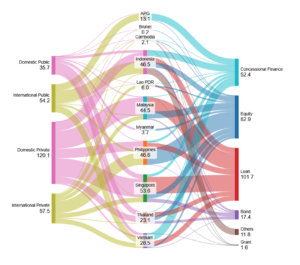 Figure 1: Existing Investment Landscape in ASEAN, 2021–2025 (USD billion).Sankey diagram showing investment flows from source (left) to country (middle) to financing instrument (right). Source: Research by ACE Partners.
The Sankey diagram above shows where the region’s USD 267.35 billion in 2021–2025 investment actually came from and where it went.
Domestic private capital was the largest single source at USD 120.1 billion, followed by international private capital (USD 57.5 billion) and international public finance (USD 54.2 billion) — domestic public capital trailed at USD 35.7 billion. On the instrument side, loans dominate at USD 101.7 billion, with equity (USD 82.9 billion) and concessional finance (USD 52.4 billion) making up most of the rest; green bonds remain a comparatively small slice at USD 17.4 billion.
The gap isn’t evenly spread. Vietnam and Indonesia each face shortfalls exceeding USD 15 billion annually, while Singapore, Malaysia, and Thailand currently run a capital surplus relative to their own national targets, capital is available regionally, but it isn’t reaching the markets that need it most.
Why the money isn’t flowing
The review points to three structural barriers:
•
Sectoral misalignment: capital concentrates in mature, debt-financed renewable generation, leaving grid expansion, system integration, energy efficiency, and the ASEAN Power Grid itself underfinanced.
•
Policy and regulatory instability: stop-and-go incentive schemes, unclear post-feed-in-tariff frameworks, and limited third-party grid access all weigh on investor confidence.
•
Systemic financing constraints: the cost of capital tells the story on its own: the median WACC for utility-scale solar PV reaches 9.4% in Indonesia, against 5.0–6.5% in advanced economies. Nonbankable PPAs and thin access to financing for MSMEs and energy service companies (ESCOs) compound the problem.
What closing it will take
Closing an USD 18.9 billion annual gap won’t come from any single fix. The review’s recommendations cluster around three areas:
•
Close the quantitative gap: scale up risk-sharing instruments like partial credit guarantees and develop a pooled ASEAN Infrastructure Blended Facility to provide first-loss capital.
•
Address the policy gap: build policy stability through clear roadmaps and transparent auction pipelines, implement Third-Party Access rules, and enable corporate PPAs alongside clear rules for storage and EV charging.
•
Strengthen the financing architecture: harmonize green bond standards, standardize PPA templates, extend blended finance beyond senior debt into subordinated and first-loss tranches, and open dedicated green credit lines for MSMEs and ESCOs.
Within that agenda, four instruments stand out as especially promising near-term priorities:
insurance and reinsurance capital mobilization to unlock institutional capital through risk-transfer mechanisms,
ESCO and energy efficiency market development to build the market infrastructure efficiency financing depends on, a
bankable direct power purchase agreement (DPPA) toolkit to standardize contracts and make corporate renewable procurement easier to finance, and a
prioritized reform sequence for policy-based loans to unlock concessional and blended finance where it’s needed most.
The gap is now well-defined country by country, source by source, instrument by instrument. The next challenge is translating that diagnosis into financing mechanisms that developers, banks, and governments can actually put to work, so that ASEAN’s clean energy ambitions are backed by capital at the scale and speed the transition demands