Beyond Participation: Ellen Bomasang on Gender, Energy, and Structural Change
This interview was originally published in SIPET Connect, the newsletter of the Southeast Asia Information Platform for the Energy Transition (SIPET).
As the energy transition accelerates, questions of inclusion are moving from the margins to the center of the conversation. But while awareness of gender in energy has grown, progress in translating that awareness into action and structural change remains limited. In this conversation, Peter du Pont, ACE Partners Co-CEO, speaks with Ellen Bomasang, a long-time development practitioner who has worked at the energy and gender nexus, about how her work in the energy sector has evolved, and what it will take to move from token inclusion to a transition that is just and equitable by design.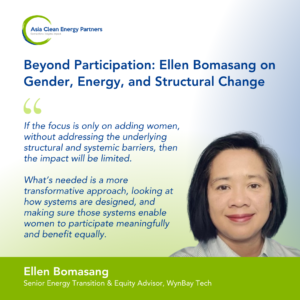 SIPET Connect: Let’s start with your journey: how did you get into the energy sector, and how has your work evolved since you started in the early 1990s?
Ellen: I’ve been working in energy since 1992, straight out of college. I started at the Philippine National Oil Company, first with its petroleum subsidiary, Petron, and then with its geothermal subsidiary, Energy Development Corporation. After that, I pursued graduate studies in Japan in public policy, focusing on energy. And then I worked at the Institute of Energy Economics, Japan.
That’s where I was first assigned to work on renewable energy and in international development. My first assignment was a a JICA-funded solar project in Zimbabwe. At the time, solar wasn’t considered mainstream at all given the high cost of the technology; it was mostly seen as something for off-grid communities with little or no chance of getting connected to the grid. Coming from work on oil and geothermal energy, that was a completely new perspective for me.
Over time, I’ve seen renewables evolve from a niche, expensive technology into a mainstream source of power. Along the way, my work has spanned policy, finance, project design, and community engagement, but what has really stayed with me is the focus on access and equity on the demand side, especially in rural and underserved communities, as well as on the supply side, particularly the energy workforce.
And I think that’s where gender naturally comes in. When you’re working on access and community-level energy systems and even in workforce development, you start to see very clearly that women and men experience and perceive energy very differently, and that those differences are often not reflected in how programs are designed.
SIPET Connect: You’ve also moved across different roles, geographies, and sub-sectors. How did you navigate that without getting locked into one track?
Ellen: It wasn’t automatic; I had to be quite intentional about it. When I moved to the U.S., I was working with International Resources Group, but they weren’t doing much in off-grid renewables at the time, which was what I was most interested in. So, I actively looked for opportunities and moved to Winrock International, where I stayed for nearly 14 years.
SIPET Connect: Yes, and that’s where you and I first met and worked together—on the USAID Eco-Asia Clean Development and Climate Program, back in 2006, where I was leading the regional effort and you were running teams in Indonesia and Vietnam.
Ellen: That’s right, this was the first large regional USAID program covering all of Asia and focusing solely on clean energy. During my time at Winrock, I did a lot of work on household energy, off-grid electrification, and community engagement, and it’s also where I started working more directly at the intersection of gender and energy.
The work was fulfilling but when I started feeling a bit pigeonholed into Asia-focused work. I wanted to branch out, both geographically and in terms of the types of roles I was taking on. So, I moved on, which led to more senior roles and opportunities to work in sub-Saharan Africa, Latin America, and the Middle East, as well as in areas like utility reform, large-scale renewables, and grid-connected power systems.
For me, it was really about actively seeking out new spaces rather than waiting for them to come.
SIPET Connect: The idea of a “gender-just energy transition” has gained traction in recent years. How have you seen the conversation on gender in energy evolve over time?
Ellen: Earlier, the conversation was much more about inclusion in a general sense. This is what we often referred to as a “just transition”—meaning not leaving anyone behind.
What I’m seeing now is a more intentional recognition that women and other marginalized groups have different needs, different perspectives, different priorities, and face different structural constraints. It’s not just about including them, but also about understanding those differences and designing systems and interventions accordingly.
In countries that are actively pursuing this, you see efforts to increase women’s participation in renewable energy jobs, to promote STEM education for girls, and to embed gender considerations into policy and resource allocation. There’s also more focus on access, making sure energy services are equitable and actually address those who feel the burden of energy poverty disproportionately.
It’s becoming more deliberate, but there’s still a long way to go in terms of implementation.
SIPET Connect: Your doctoral research looks at women of color in international development. What led you to focus on that?
Ellen: It was really inspired by my own experiences in the US development industry, as well as those shared by colleagues. My research looks at how women of color who work as practitioners experience power, oppression, and privilege within the industry. I was promoting equity in my work with governments and utilities, but ironically experiencing inequity in my immediate work environment. I felt that needed to be explored.
I focused on energy, which is still very male-dominated, and the health sector, which is more diverse, to draw some comparisons. I conducted in-depth interviews with women of color and also spoke with practitioners from different backgrounds to get a fuller picture.
What comes through very clearly is that there are interlocking barriers – structural, disciplinary, hegemonic and interpersonal – and they’re not always visible in the way organizations think about inclusion.
SIPET Connect: From your experience, what are the most persistent barriers that hold women back in the energy transition?
Ellen: There are quite a few, and they tend to reinforce each other. Education and skills are a big one. Women are still underrepresented in technical fields, and that carries through into the workforce. Even in renewables, representation is only around 30 percent globally, and lower in the broader energy sector.
Then, there’s how the labor market is structured. Technical, field, and leadership roles are still dominated by men, and hiring often relies on networks that women don’t have the same access to.
There are also structural biases in policies and institutions. Even when things appear neutral, they often don’t account for realities like caregiving responsibilities, which affect women disproportionately.
Time poverty is another factor. Women are still managing multiple roles, childcare, household responsibilities, and in most rural contexts fuel and water collection, which limits their ability to participate in training, employment, or entrepreneurship. It also affects the amount of time they have for recreation and rest – which impacts their health and wellbeing.
And there are social norms. In many places, technical roles are still seen as men’s work. I’ve seen programs where only men were recruited for technical training, even though women might have been more likely to stay and apply those skills locally.
Finally, workplace culture can be a barrier, especially in male-dominated settings where there may be safety concerns, lack of mentorship, or limited support systems.
SIPET Connect: What have you seen actually work in moving beyond awareness to real change?
Ellen: One of the biggest lessons is that it’s not enough to simply increase participation. That was the approach for a long time, train more women, include more women. and then consider the job done.
What works better is addressing the underlying structural issues. That includes changing hiring practices, creating mentorship opportunities, and improving workplace culture so that women can actually thrive once they enter the sector.
Engaging men is also critical. In some of the programs I’ve worked on, bringing men into the conversation, helping them understand how certain behaviors or norms affect their colleagues, has made a real difference.
There’s also a strong case for starting early. We’ve done work with girls at the middle school level, introducing them to engineering and technical careers and connecting them with role models. That’s often the stage where career aspirations start to take shape.
And something that’s often overlooked is leadership training. Many programs focus on technical skills, but women also need support in navigating workplaces, negotiating, and advancing into leadership roles. In one program in Nigeria, we trained close to a thousand women in leadership skills, and it was very well received and later replicated in other West African countries, Jordan, and Mongolia.
I believe it’s really about addressing the full spectrum, from education to workplace dynamics to leadership.
SIPET Connect: Is there a risk that gender remains treated as a side issue rather than being fully integrated?
Ellen: Yes, and that has been the case for a long time. When gender is treated as a separate track or an add-on, it is not treated with the importance it deserves, and can actually create resistance.
I remember working on a project in Mongolia where we included a gender track in an energy conference. Some participants questioned why it was there at all, saying there were more “serious” issues to discuss.
That reflects a broader challenge. Gender is often labeled as cross-cutting, but it’s not given the same weight as technical components. When budgets are tight, it’s often the first thing to be cut. When programs are downsized, it is the first thing to be eliminated.
Where it works better is when leadership takes it seriously. If the project lead or the funder understands that it is integral to overall success, prioritizes it and integrates it into the core design of the program, then it becomes part of how the work is done, rather than something separate.
SIPET Connect: How do you see the role of gender lens investing and related approaches evolving?
Ellen: There’s definitely more interest, but adoption is still uneven. In some of the work I’m doing now, we’re trying to integrate gender considerations into procurement processes, for example, assessing companies based on how inclusive their workplace policies are. But even then, there’s a question of how many companies will actually meet those criteria.
The evidence is quite clear that more inclusive workplaces lead to better outcomes, but that hasn’t fully translated into widespread practice yet.
SIPET Connect: Finally, what is one key takeaway you would leave for practitioners working on gender and energy?
Ellen: The main takeaway is that this is not just about participation.
If the focus is only on adding women, without addressing the underlying structural and systemic barriers, then the impact will be limited. What’s needed is a more transformative approach, looking at how systems are designed, whether that’s financing, labor markets, or energy access, and making sure those systems enable women to participate meaningfully and benefit equally. Gender-disaggregated data-gathering should also be conducted to ensure informed decision-making and accountability.
A gender-just energy transition is really about ensuring that women are not only included, but that they have equitable access to opportunities and a role in shaping the transition itself.
SIPET Connect: Let’s start with your journey: how did you get into the energy sector, and how has your work evolved since you started in the early 1990s?
Ellen: I’ve been working in energy since 1992, straight out of college. I started at the Philippine National Oil Company, first with its petroleum subsidiary, Petron, and then with its geothermal subsidiary, Energy Development Corporation. After that, I pursued graduate studies in Japan in public policy, focusing on energy. And then I worked at the Institute of Energy Economics, Japan.
That’s where I was first assigned to work on renewable energy and in international development. My first assignment was a a JICA-funded solar project in Zimbabwe. At the time, solar wasn’t considered mainstream at all given the high cost of the technology; it was mostly seen as something for off-grid communities with little or no chance of getting connected to the grid. Coming from work on oil and geothermal energy, that was a completely new perspective for me.
Over time, I’ve seen renewables evolve from a niche, expensive technology into a mainstream source of power. Along the way, my work has spanned policy, finance, project design, and community engagement, but what has really stayed with me is the focus on access and equity on the demand side, especially in rural and underserved communities, as well as on the supply side, particularly the energy workforce.
And I think that’s where gender naturally comes in. When you’re working on access and community-level energy systems and even in workforce development, you start to see very clearly that women and men experience and perceive energy very differently, and that those differences are often not reflected in how programs are designed.
SIPET Connect: You’ve also moved across different roles, geographies, and sub-sectors. How did you navigate that without getting locked into one track?
Ellen: It wasn’t automatic; I had to be quite intentional about it. When I moved to the U.S., I was working with International Resources Group, but they weren’t doing much in off-grid renewables at the time, which was what I was most interested in. So, I actively looked for opportunities and moved to Winrock International, where I stayed for nearly 14 years.
SIPET Connect: Yes, and that’s where you and I first met and worked together—on the USAID Eco-Asia Clean Development and Climate Program, back in 2006, where I was leading the regional effort and you were running teams in Indonesia and Vietnam.
Ellen: That’s right, this was the first large regional USAID program covering all of Asia and focusing solely on clean energy. During my time at Winrock, I did a lot of work on household energy, off-grid electrification, and community engagement, and it’s also where I started working more directly at the intersection of gender and energy.
The work was fulfilling but when I started feeling a bit pigeonholed into Asia-focused work. I wanted to branch out, both geographically and in terms of the types of roles I was taking on. So, I moved on, which led to more senior roles and opportunities to work in sub-Saharan Africa, Latin America, and the Middle East, as well as in areas like utility reform, large-scale renewables, and grid-connected power systems.
For me, it was really about actively seeking out new spaces rather than waiting for them to come.
SIPET Connect: The idea of a “gender-just energy transition” has gained traction in recent years. How have you seen the conversation on gender in energy evolve over time?
Ellen: Earlier, the conversation was much more about inclusion in a general sense. This is what we often referred to as a “just transition”—meaning not leaving anyone behind.
What I’m seeing now is a more intentional recognition that women and other marginalized groups have different needs, different perspectives, different priorities, and face different structural constraints. It’s not just about including them, but also about understanding those differences and designing systems and interventions accordingly.
In countries that are actively pursuing this, you see efforts to increase women’s participation in renewable energy jobs, to promote STEM education for girls, and to embed gender considerations into policy and resource allocation. There’s also more focus on access, making sure energy services are equitable and actually address those who feel the burden of energy poverty disproportionately.
It’s becoming more deliberate, but there’s still a long way to go in terms of implementation.
SIPET Connect: Your doctoral research looks at women of color in international development. What led you to focus on that?
Ellen: It was really inspired by my own experiences in the US development industry, as well as those shared by colleagues. My research looks at how women of color who work as practitioners experience power, oppression, and privilege within the industry. I was promoting equity in my work with governments and utilities, but ironically experiencing inequity in my immediate work environment. I felt that needed to be explored.
I focused on energy, which is still very male-dominated, and the health sector, which is more diverse, to draw some comparisons. I conducted in-depth interviews with women of color and also spoke with practitioners from different backgrounds to get a fuller picture.
What comes through very clearly is that there are interlocking barriers – structural, disciplinary, hegemonic and interpersonal – and they’re not always visible in the way organizations think about inclusion.
SIPET Connect: From your experience, what are the most persistent barriers that hold women back in the energy transition?
Ellen: There are quite a few, and they tend to reinforce each other. Education and skills are a big one. Women are still underrepresented in technical fields, and that carries through into the workforce. Even in renewables, representation is only around 30 percent globally, and lower in the broader energy sector.
Then, there’s how the labor market is structured. Technical, field, and leadership roles are still dominated by men, and hiring often relies on networks that women don’t have the same access to.
There are also structural biases in policies and institutions. Even when things appear neutral, they often don’t account for realities like caregiving responsibilities, which affect women disproportionately.
Time poverty is another factor. Women are still managing multiple roles, childcare, household responsibilities, and in most rural contexts fuel and water collection, which limits their ability to participate in training, employment, or entrepreneurship. It also affects the amount of time they have for recreation and rest – which impacts their health and wellbeing.
And there are social norms. In many places, technical roles are still seen as men’s work. I’ve seen programs where only men were recruited for technical training, even though women might have been more likely to stay and apply those skills locally.
Finally, workplace culture can be a barrier, especially in male-dominated settings where there may be safety concerns, lack of mentorship, or limited support systems.
SIPET Connect: What have you seen actually work in moving beyond awareness to real change?
Ellen: One of the biggest lessons is that it’s not enough to simply increase participation. That was the approach for a long time, train more women, include more women. and then consider the job done.
What works better is addressing the underlying structural issues. That includes changing hiring practices, creating mentorship opportunities, and improving workplace culture so that women can actually thrive once they enter the sector.
Engaging men is also critical. In some of the programs I’ve worked on, bringing men into the conversation, helping them understand how certain behaviors or norms affect their colleagues, has made a real difference.
There’s also a strong case for starting early. We’ve done work with girls at the middle school level, introducing them to engineering and technical careers and connecting them with role models. That’s often the stage where career aspirations start to take shape.
And something that’s often overlooked is leadership training. Many programs focus on technical skills, but women also need support in navigating workplaces, negotiating, and advancing into leadership roles. In one program in Nigeria, we trained close to a thousand women in leadership skills, and it was very well received and later replicated in other West African countries, Jordan, and Mongolia.
I believe it’s really about addressing the full spectrum, from education to workplace dynamics to leadership.
SIPET Connect: Is there a risk that gender remains treated as a side issue rather than being fully integrated?
Ellen: Yes, and that has been the case for a long time. When gender is treated as a separate track or an add-on, it is not treated with the importance it deserves, and can actually create resistance.
I remember working on a project in Mongolia where we included a gender track in an energy conference. Some participants questioned why it was there at all, saying there were more “serious” issues to discuss.
That reflects a broader challenge. Gender is often labeled as cross-cutting, but it’s not given the same weight as technical components. When budgets are tight, it’s often the first thing to be cut. When programs are downsized, it is the first thing to be eliminated.
Where it works better is when leadership takes it seriously. If the project lead or the funder understands that it is integral to overall success, prioritizes it and integrates it into the core design of the program, then it becomes part of how the work is done, rather than something separate.
SIPET Connect: How do you see the role of gender lens investing and related approaches evolving?
Ellen: There’s definitely more interest, but adoption is still uneven. In some of the work I’m doing now, we’re trying to integrate gender considerations into procurement processes, for example, assessing companies based on how inclusive their workplace policies are. But even then, there’s a question of how many companies will actually meet those criteria.
The evidence is quite clear that more inclusive workplaces lead to better outcomes, but that hasn’t fully translated into widespread practice yet.
SIPET Connect: Finally, what is one key takeaway you would leave for practitioners working on gender and energy?
Ellen: The main takeaway is that this is not just about participation.
If the focus is only on adding women, without addressing the underlying structural and systemic barriers, then the impact will be limited. What’s needed is a more transformative approach, looking at how systems are designed, whether that’s financing, labor markets, or energy access, and making sure those systems enable women to participate meaningfully and benefit equally. Gender-disaggregated data-gathering should also be conducted to ensure informed decision-making and accountability.
A gender-just energy transition is really about ensuring that women are not only included, but that they have equitable access to opportunities and a role in shaping the transition itself.